
Hash Boards, Heat and the 112 TH/s Payback
Payback is a local number: it depends on what the hardware cost, what the power costs and what the network pays. At 112 TH/s, current conditions produce 5.024e-05 BTC a day, worth $4.26 at $84,692 per BTC, or $4.09 after the listed 4% on the block-reward component. Those figures set the revenue side of the payback, not the answer.
Key takeaways
- At 112 TH/s, daily output is 5.024e-05 BTC, or $4.26 gross and $4.09 net of the listed 4% on the block-reward component.
- At 1.12 PH/s the same inputs give 0.00050244 BTC a day, $42.55 gross and $40.85 net.
- Payback needs the purchase price and the power cost, which the pool formula does not supply.
- PPS+ settles hourly against current difficulty; PPLNS settles after 6 confirmations across the last 5 difficulty rounds.
Payback is a local number
Two miners can run identical machines and get different payback periods. One pays less for power, one pays less for the hardware, and one runs in a cooler room that avoids derating. The network sets the revenue per terahash, but it does not set the cost. That is why a payback estimate copied from a forum thread is usually wrong for the person reading it.
The honest approach is to build the estimate from three local numbers: the delivered cost of the machine, the daily power cost and the daily net payout. The first two come from invoices. The third comes from the formula, and it changes with difficulty and price. A payback estimate is therefore a range, not a date, and it should be recalculated when any of the three inputs moves.
What one hash board produces
A machine's hashrate is the sum of its boards, so a board-level view is useful for maintenance and for partial failures. If a 112 TH/s unit has three boards and one drops out, the reported hashrate falls by roughly a third and the daily output falls with it. The pool still pays for the shares that arrive, so the loss is proportional rather than total. An alert or a daily check catches it before a month of reduced output passes.
The ViaBTC Bitcoin Mining account reports the submitted hashrate, which is the number that reflects a missing board. PPS+ pays hourly against current difficulty, so the reduced output appears in the next payment. PPLNS pays after 6 confirmations across the last 5 difficulty rounds, which can blur the timing but not the total.
Three board counts
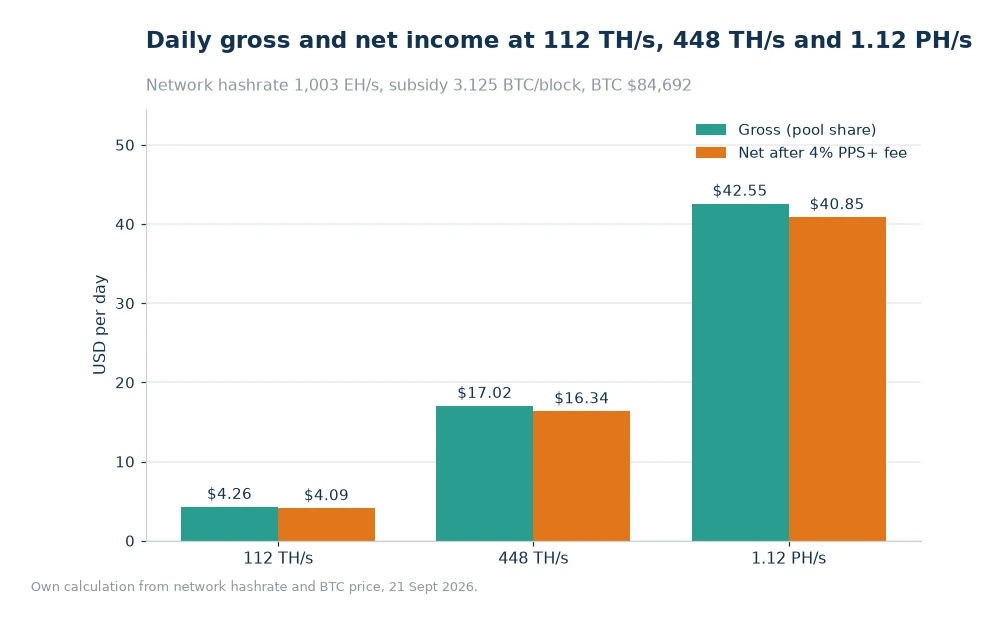
The rows below are one unit, four units and ten units. The net column applies the listed 4% to the block-reward component and excludes power, which is the cost that varies most between locations. The table is a revenue ladder, not a payback calculation.
| Hashrate | BTC per day | Gross USD per day | Net USD per day |
|---|---|---|---|
| 112 TH/s | 0.00005024 | $4.26 | $4.09 |
| 448 TH/s | 0.00020098 | $17.02 | $16.34 |
| 1.12 PH/s | 0.00050244 | $42.55 | $40.85 |
The middle row is four times the first, and the top row is ten times the first. At the single-unit level, a month of net output is about $122.70 before power. If the machine cost $1,200 and the power bill is $60 a month, the simple payback is roughly 1,200 divided by 62.70, or just over 19 months, before any difficulty change. That is the shape of the calculation, not a forecast.
Heat per terahash
Every watt that goes into a miner leaves as heat, so a more efficient machine produces less heat for the same hashrate. That matters twice: the power bill is lower, and the cooling load is lower. In a small room the second effect can be as large as the first, because an inefficient machine may need more airflow than the space can provide without an additional fan or a larger vent.
A board-level check is a useful maintenance habit. Look for a board that runs hotter than its neighbours, a fan that spins faster than the others, or a heat sink with a dust film. Those are early signs of a derating event, and they are cheaper to fix than a failed board. The daily payout will confirm whether the fix worked, because the reported hashrate returns to the nameplate figure.
The difficulty slope
Payback estimates often assume a constant daily payout, which is the weakest part of the calculation. Difficulty generally changes every 2,016 blocks, and the next estimate is minus 2.12%, which would raise output per terahash slightly if it holds. A single adjustment in either direction is small, but a series of them over a year can move the payback period by months, especially when the machine is marginal at the start.
A better estimate uses two scenarios: the current payout and a deliberately lower one. If the machine pays back within a reasonable period under the lower scenario, the estimate has some resilience. If it only pays back under the current one, the payback period is a bet on difficulty and price staying favourable, and it should be described that way before the purchase.
Worked example
Take 112 TH/s and run the chart arithmetic with the inputs read on 21 Sept 2026.
- Daily BTC per TH/s is 450 divided by 1,003,000,000, which equals 4.4865e-07.
- Multiply by 112: 4.4865e-07 times 112 equals 5.0249e-05 BTC, shown as 5.024e-05.
- Multiply by the BTC price: 5.0249e-05 times $84,692 equals $4.26 gross.
- Apply the listed 4% to the block-reward component: 4% of $4.26 is $0.17, leaving $4.09 net.
- Multiply by four for 448 TH/s: 0.00020098 BTC, $17.02 gross and $16.34 net.
- Multiply by ten for 1.12 PH/s: 0.00050244 BTC, $42.55 gross and $40.85 net.
- Thirty days at 112 TH/s nets about $122.70 before power; subtract a $60 power bill and the monthly contribution is about $62.70.
Compare models on the same revenue basis
The Miner Profitability Ranking puts current models on a common basis of price and difficulty, which is useful for a shortlist. It cannot know your delivered hardware cost or your power rate, so treat the ranking as a starting filter rather than a payback answer. The final comparison belongs in your own worksheet, with your own invoices.
Write the purchase price, the monthly net after power and the lower-scenario monthly net. Divide the price by each monthly figure to get a range. If the range is acceptable, the machine has a case; if the upper end is far beyond the life of the hardware, the case depends on a market move rather than on the mining.
Frequently asked questions
How long is the payback at 112 TH/s?
It depends on the purchase price and the power cost. At current inputs the net is about $122.70 a month before power, so a $1,200 machine with a $60 monthly bill has a simple payback of just over 19 months.
What happens if one hash board fails?
The reported hashrate falls by roughly that board's share, and the daily BTC falls in proportion. PPS+ shows the change in the next hourly payment, while PPLNS spreads it across the settlement window.
Does a lower difficulty shorten payback?
Yes, slightly, because the same hashrate earns more per day when difficulty falls. The next estimate is minus 2.12%, which is a small effect compared with a change in hardware price or power cost.
Build the range, not the date
Take the daily net, multiply by 30, subtract the power bill, and divide the hardware price by the result. Then repeat with a lower payout. At 112 TH/s the first pass gives about $62.70 a month after a $60 power bill. The second pass is the number that matters, because it shows how much of the payback depends on conditions staying favourable.
Sources: the ViaBTC homepage for the pool setup and the fee schedule for the listed 4% and 2% rates. Network hashrate 1,003 EH/s, difficulty 132.76 T, subsidy 3.125 BTC per block, 450 BTC daily and BTC $84,692 were read 21 Sept 2026, published 22 Oct 2026[1]. Every dollar figure is arithmetic on those inputs and moves when they move.